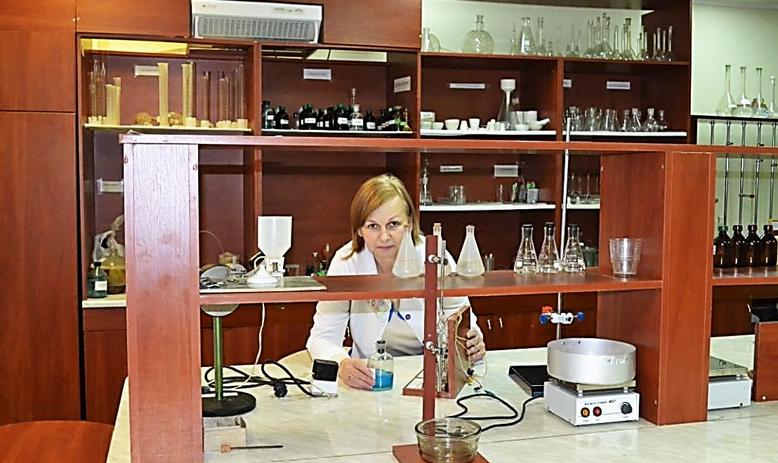
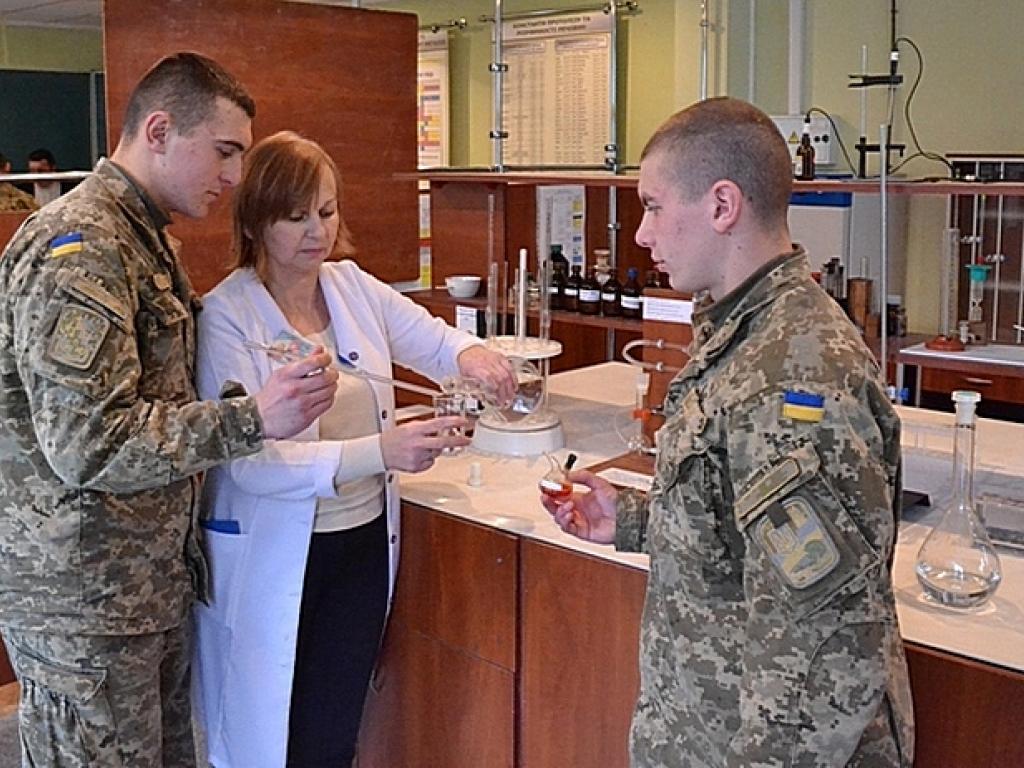
The Laboratory of General and Inorganic Chemistry and Hydraulics is located in room 342 of the educational building No. 3 of the Hetman Petro Sahaidachnyi National Army Academy. The laboratory was established in 2011. The head of the laboratory is Olha Koval. The curator of the laboratory is Associate Professor of the Department, Candidate of Chemical Sciences Liubomyra Odosiy. Yuriy Shabatura, Head of the Department of Electromechanics and Electronics, and Stepan Kozak, Candidate of Chemical Sciences, Associate Professor, take an active part in the development of the laboratory.
 |
 |
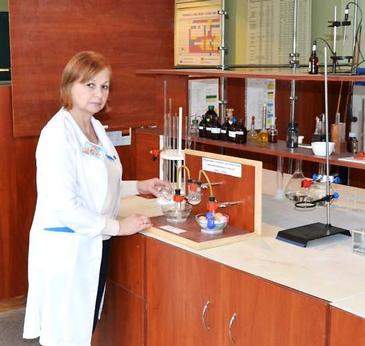
| Head of the laboratory Koval Olga Petrovna |
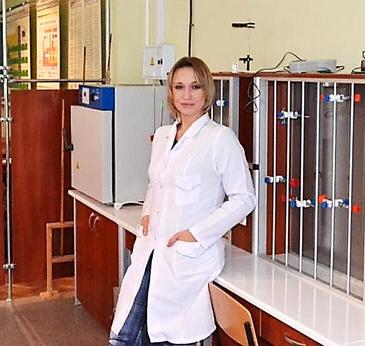
Curator of the laboratory Candidate of Chemical Sciences Associate professor of the department Odosiy Lyubomyra Ihorivna |
Today, the laboratory provides training for cadets and part-time students in the following areas: ● Engineering Mechanics, ● Military Administration, ● Motor Vehicle Transport. The laboratory is designed for laboratory work in the discipline “Chemistry”, and provides laboratory classes in hydraulics, which is an integral part of the discipline “Fundamentals of Metrology, Hydraulics and Chemistry, Gunpowder and Explosives”. In the study of disciplines, considerable attention is paid to the laboratory workshop, which is published by the scientific and pedagogical staff of the department.
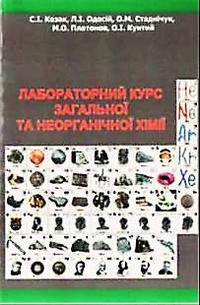 Study guide / S.I. Kozak, L.I. Odosiy, O.M. Stadnichuk and others - Lviv: DIA, 2014. - 234 |
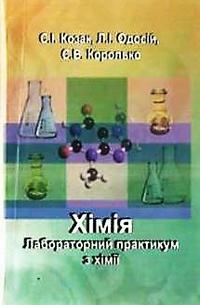 Kozak S.I., Odosiy L.I., Korolko S.V. Chemistry. Laboratory workshop on chemistry: a textbook. - Lviv: DIA, 2011. - 216 p. |
Mastering the theoretical material, the scope of which is determined by the course curriculum, depends on the correct organization of laboratory work, the task of which is not only to give the cadet the skills to conduct an experiment, competently and consistently perform it, but also to teach the cadet to think independently, draw correct conclusions and competently apply the acquired knowledge in further military affairs. To this end, the laboratory is equipped with the appropriate instruments and equipment necessary for laboratory tests and visual experiments. In particular, the laboratory staff and the head of the laboratory have constructed laboratory installations that are actively used in laboratory work to confirm the theoretical positions on the main topics and sections of the relevant disciplines. The laboratory is equipped with the following devices: ● distiller; ● pH meter 150 MI (determination of the pH of the medium of solutions and liquids), ● technical scales; ● technical electronic scales (weighing samples of materials, bulk solids, and liquids), ● psychrometric hygrometer (designed to determine air humidity); The material base of the laboratory is complemented by developed rationalization proposals that are good visual exhibits.
The laboratory is equipped with the following facilities:
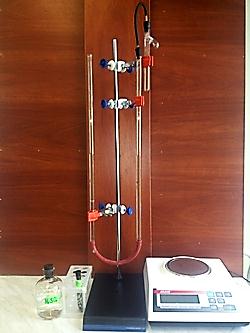 Laboratory unit for determining the molar mass of gas |
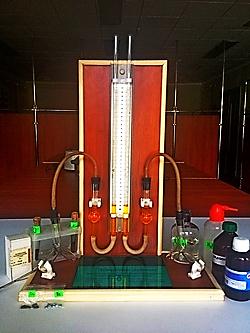 Laboratory setup for studying the kinetic characteristics of the rate of chemical reactions |
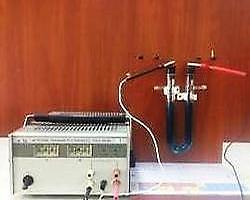 Laboratory setup for demonstration of solution electrolysis |
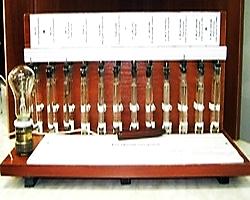 Laboratory setup for determining the properties of electrolyte solutions |
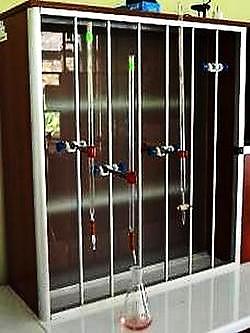 Laboratory unit for preparation of solutions of a certain concentration |
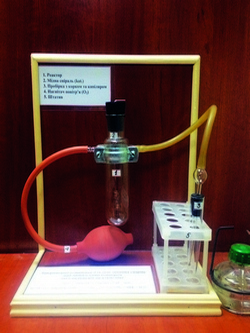 Laboratory unit for determining the qualitative and quantitative analysis of individual organic substances |
The material and technical support of the laboratory allows for high-quality and affordable laboratory and practical classes on the following topics: ● Basic characteristics of explosives and gunpowder; ● Thermodynamic and kinetic characteristics of explosives and gunpowder; ● Inorganic explosives and gunpowder; ● Organic explosives; ● Fundamentals of electrochemistry; List of laboratory works conducted in the laboratory: 1. Technique of performing individual experiments 2. Determination of the molar mass of metal equivalent 3. Experimental determination of the molar mass of gases 4. Study of the properties of elements and their compounds depending on their location in the periodic table of D. I. Mendeleev 5. General properties of metals 6. Production and properties of oxides 7. Extraction and preparation of acids 8. Preparation and properties of soluble and insoluble bases 9. Salts. Preparation and properties 10. Preparation of complex compounds 11. Preparation of solutions of a certain concentration 12. Determination of the properties of electrolyte solutions 13. Determination of signs of ionic reactions 14. Hydrolysis of salts 15. Study of the rate of chemical reactions and chemical equilibrium 16. Determination of the thermal effect of the reaction 17. Redox reactions 18. Electrolysis 19. Galvanic cells, the effect of solution concentration on the emf of the galvanic cell 20. Corrosion of metals 21. Methods of exposure to metal as a method of protection against corrosion 22. Chemical properties of alkali metals and their compounds 23. Chemical properties of alkaline earth metals and their compounds 24. Water hardness 25. Chemical properties of aluminum 26. Chemical properties of carbon and its compounds 27. Chemical properties of silicon and its compounds 28. Chemical properties of nitrogen and its compounds 29. Chemical properties of phosphorus and its compounds 30. Chemical properties of sulfur and its compounds 31. Chemical properties of halogens and their compounds 32. Chemical properties of copper 33. Chemical properties of chromium 34. Chemical properties of manganese 35. Chemical properties of ferrum